
English 
T: +86-571-8663-6649
E: hzbjys@hzbjys.com
E: hzbjys@hzbjys.com
7/F, 1st Building Of ZhongHao WangJiang International Center, NO.332 East WangJiang Road, HangZhou, ZheJiang, China.
Views: 0 Author: Site Editor Publish Time: 2026-10-14 Origin: Site


You may wonder: does brass rust? The direct answer is no. Brass holds no iron, so it cannot form rust the way steel does. However, brass does tarnish and can corrode over time. People often confuse these two processes. Rust eats into iron-based metals and weakens them. Tarnish only darkens the surface of brass, whether you own a brass sheet or a brass strip. This post explains that difference clearly. You will also see how brass compares with pure copper, and you will learn simple steps to prevent tarnish and keep your brass items looking their best.
Brass never rusts because it contains no iron.
Tarnish darkens the surface but does not weaken the metal.
Watch for green spots or pink patches to spot corrosion early.
Clean brass with mild soapy water and dry it completely.
Apply wax or lacquer to protect brass and extend its life.
Only metals that contain iron can rust. Brass does not contain iron, so brass technically does not rust. This simple fact answers the common question: does brass rust? The answer stays the same whether you own a brass sheet, a brass rod, or a decorative brass strip.
Brass is an alloy of copper and zinc. Pure copper holds no iron either. The University of Illinois physics Q&A explains that brass combines copper's low reactivity with zinc's strength. This brass alloy resists rust in the same fashion as pure copper. Neither metal can form iron oxide, the flaky red-brown layer that damages steel. You may ask, does water cause brass to rust? Water alone cannot trigger rust on brass because the alloy lacks iron. In short, brass cannot rust in water or in humid air. The reason why brass doesn't rust comes down to chemistry: no iron means no rust.
Brass does tarnish over time. Oxygen, moisture, and environmental contaminants react with the surface of the metal. This reaction creates a dark, dull, or discolored layer. That layer is tarnish, not rust. Vintage Faucets notes that exposure to air and moisture drives oxidation of the copper and zinc in the alloy. Skin oils and acidic substances can speed up the process.
So does brass tarnish in everyday settings? Yes, and regular handling makes it more likely. Sulfur compounds in the air add to the effect. The metal can lose its shine and develop a darker surface. It never corrodes in the same fashion as steel, though. Brass and copper each fit different needs, and both resist rust well. A polished brass fitting may call for occasional care, while a copper part suits other jobs. Neither choice is better; each serves its purpose.
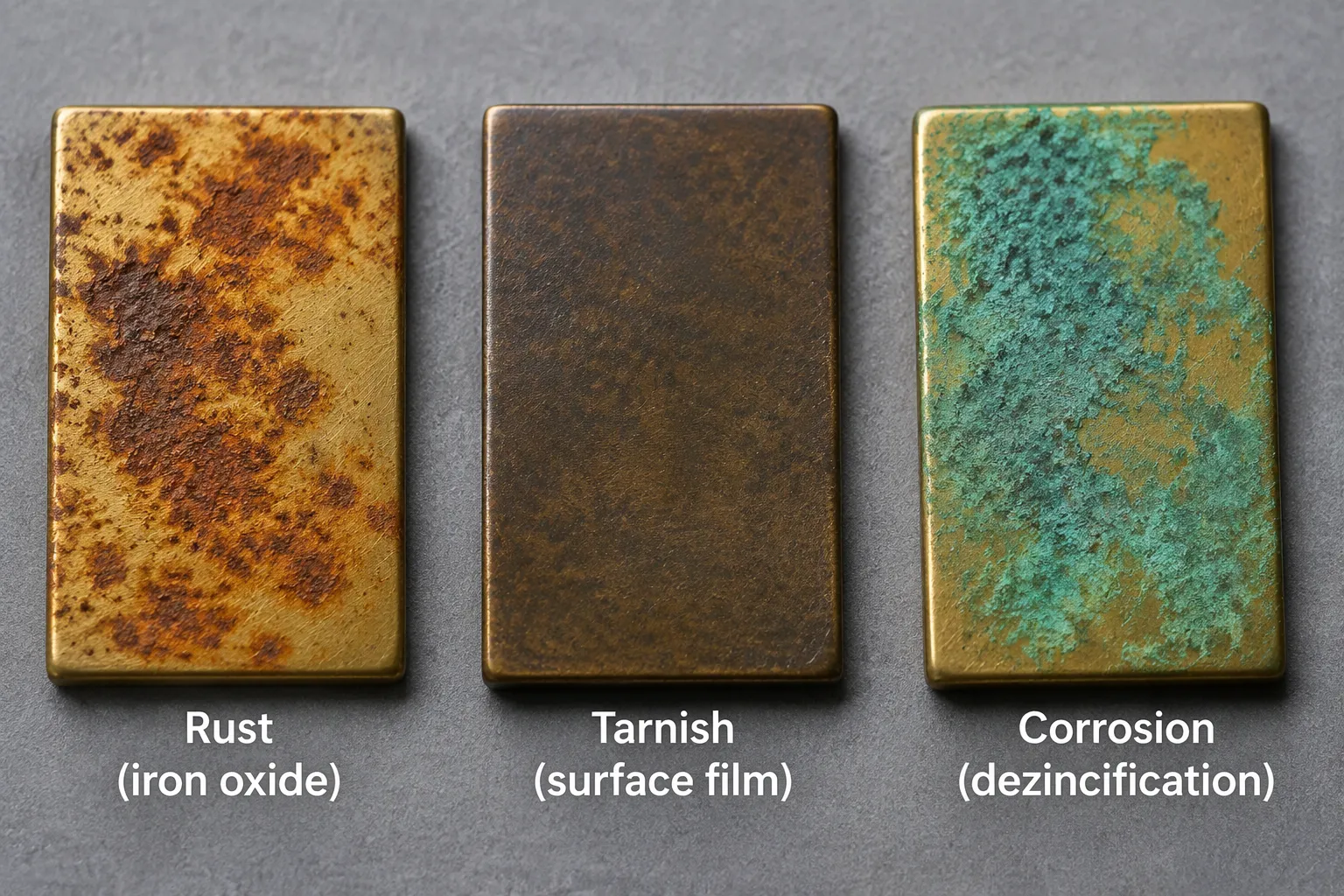
Rust is a general name for a mix of iron oxides and hydroxides. Wikipedia explains that rust forms when iron or alloys with iron sit exposed to oxygen and moisture for a long time. This process is an oxidation reaction that only happens to iron. Iron gives up electrons, oxygen gains them, and the result is iron oxide. You can sum up the reaction in plain terms: iron plus oxygen plus water equals iron oxide. The color ranges from red-orange to reddish-brown. Rust can occur on any metals that contain iron, including steel, cast iron, and wrought iron. Humidity, oxygen levels, and the metal type all change how fast rust appears. This is the key point for the difference between rust, tarnish, and corrosion in brass: rust needs iron, and brass has none.
Tarnish is a thin surface layer that darkens brass but does not flake off or go deep. The copper in the alloy reacts with sulfur, oxygen, or moisture. JH MIM notes that this film often works as a protective barrier against more attack. It affects only how the surface looks and does not make the material weaker. You see a dull, brown-gray film that wipes away fairly easily. Copper oxide creates dark brown to black films, while zinc oxide forms white deposits in zinc-rich areas.
Corrosion is a broader breakdown of the surface. In brass, one form is dezincification, where zinc dissolves and leaves a porous, copper-rich structure with weaker mechanical strength. JH MIM reports that brass with more than 15% zinc shows susceptibility. Stress corrosion cracking is another form, and it develops when tensile stress and corrosive agents such as ammonia or chlorides act at the same time.
The corrosion resistance of brass is still quite good. Because of this, brass corrosion is usually slow and stays near the surface. You will rarely see brass corrode through the way steel does. Watch for dulling, darkening, and occasional green films, and treat them early.
Brass is a mix of copper and zinc. The amount of zinc can vary widely. That amount decides how strong the metal is, how easily it bends, and what color it has, says Thin Metal Sales. Brass with little zinc stays soft and reddish, which works well for detailed designs. Brass with a lot of zinc looks paler and feels stiffer, and it holds up better against wear. Total Materia lists some common types: C 23000 red brass has 85% copper and 15% zinc, C 26000 cartridge brass has 70% copper and 30% zinc, and C 28000 Muntz Metal has 60% copper and 40% zinc.
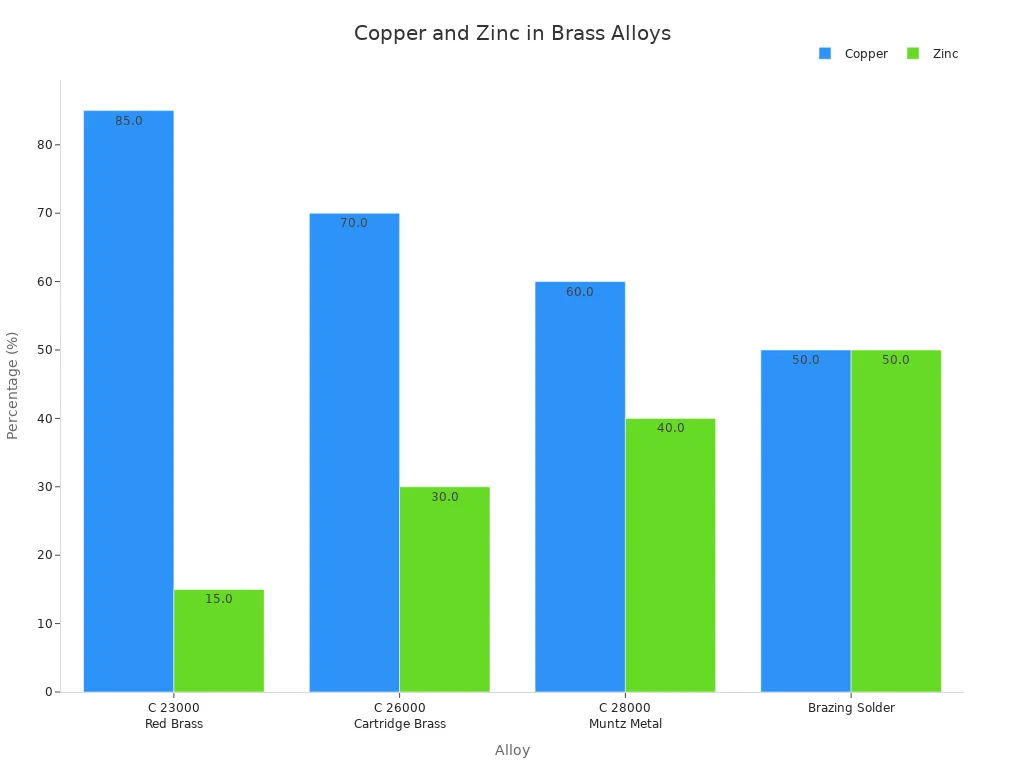
This brass mix has no iron in it, and that one fact tells you why brass doesn't rust. You get a strong material that keeps its shape when stress is put on it. Pure copper might bend or dent more easily under the same load, so each metal is right for a different job instead of one being better than the other.
Adding zinc does more than make the metal harder. Thin Metal Sales says the extra zinc makes copper less likely to corrode in wet places, but going past about 40 percent zinc can weaken that protection a little. Total Materia notes that brass usually stands up to sulfur compounds better than pure copper does. The downside: brass with more than 15% zinc can crack under stress when it meets ammonia, according to HGHouston.
As zinc goes up, conductivity goes down. Yellow brass reaches about 28% IACS, while pure copper sits at 100% IACS, according to Prolean. Even so, brass mixes are still useful for electrical work, including busbars.
You can also put the two metals together without worry. Balkan Plumbing explains that galvanic corrosion hits unlike metals such as galvanized pipe joined to copper or brass, not brass joined to copper. The two sit close together on the galvanic scale, so contact between them is barely a risk.
Several things affect how well brass resists corrosion. The grade sets the zinc level. Humidity, chlorides, temperature, water chemistry, and chemical exposure all play a part. Surface finish and coatings change how much of the metal touches the air. Hztargetmetal groups these factors simply: moisture speeds up surface weathering, salt raises the risk of localized attack, and ammonia becomes a problem when tensile stress is present. Acids and industrial chemicals can break down protective films. A dry indoor setting treats brass far more gently than a humid industrial space.
You can spot trouble early by watching the color. Sheetmetalmasion describes light tarnish as a flat layer that dims the metal. Heavy tarnish turns the surface brown or black. Long exposure to air and moisture builds verdigris, a green-blue film. Xtj-cnc warns that powdery green spots, flaking, pitting, or pink patches point to deeper corrosion. That pink color signals oxidation or a process known as dezincification, where zinc leaches out and leaves porous copper behind. For harsh settings, choose dezincification resistant brass, naval brass, or Admiralty brass.
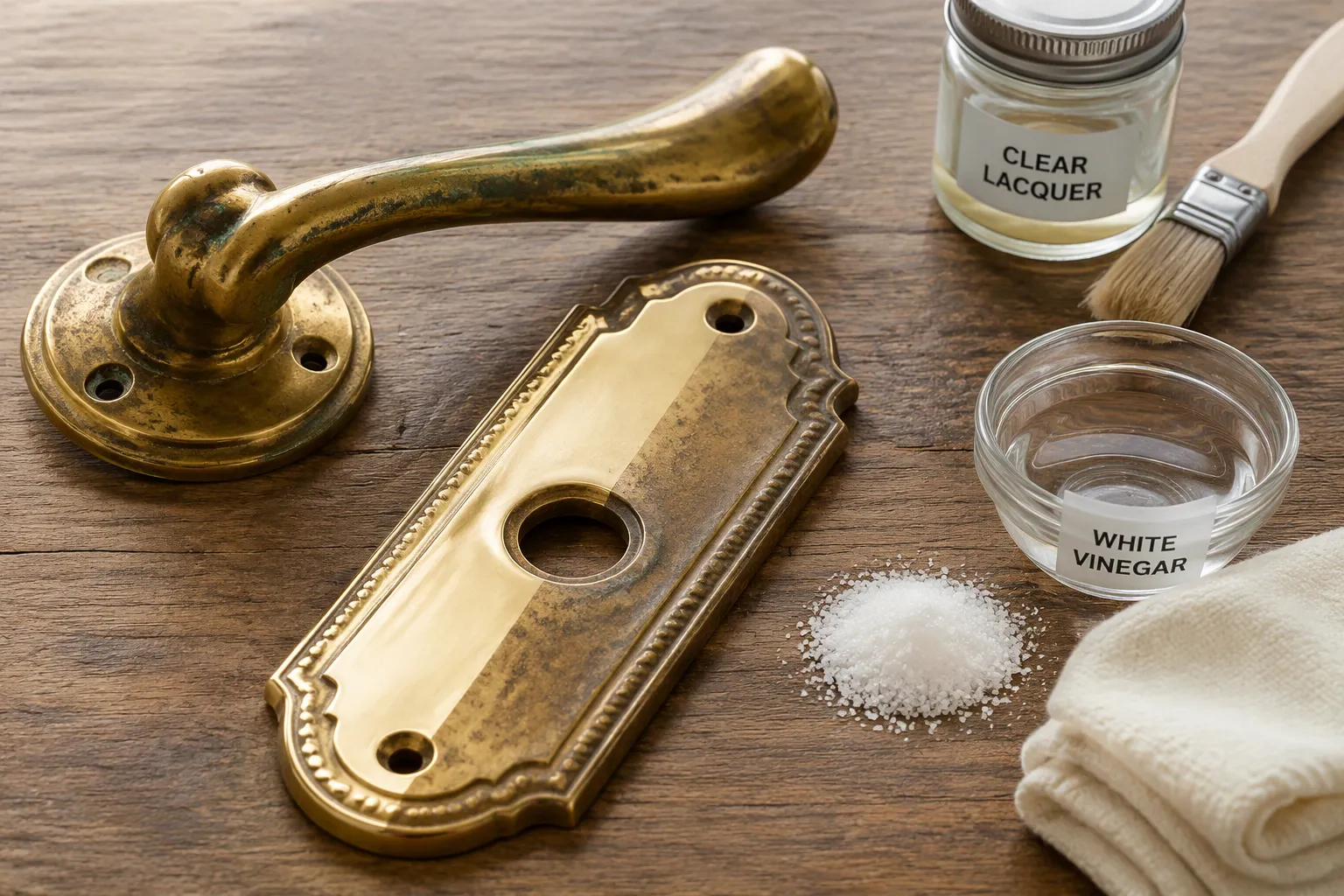
Start with the gentlest method that works. Wash the piece in mild soapy water, rinse well, and dry it completely. For heavier tarnish, a vinegar, salt, and flour paste lifts the film, but rinse it off promptly. Commercial brass cleaners act fast, so test them on a hidden spot first. Food-contact parts need a neutral food-grade detergent and a thorough rinse. After any acid cleaner, casting-china.org recommends a dip in 0.3%–0.5% sodium bicarbonate solution for 1–2 minutes, then a clean water rinse and full drying. Keep hot-air drying at or below 60°C.
A protective barrier slows tarnishing a great deal. Clear lacquer keeps polished brass bright for years, though chips let tarnish creep in unevenly. Partmfg suggests nitrocellulose lacquer indoors and Incralac outdoors. Renaissance Wax, a microcrystalline wax, lasts several months. Unlacquered brass darkens freely and you can polish it whenever you like. These habits serve brass sheets, rods, strips, foils, and busbars alike, wherever each form fits best.
The metal holds no iron, so it cannot rust. That settles the question many buyers ask: does brass rust? The answer stays no. Tarnish is a different story. Oxygen, moisture, and sulfur darken the surface over time, and harsh settings can corrode the metal slowly. Watch for dulling, dark patches, and green films. Wash with mild soapy water, dry fully, then seal with wax or lacquer. Brass resists corrosion well. Copper tarnishes in much the same way, so choose the metal that fits your project. A little routine care keeps your brass pieces bright for years.
Yes. The alloy holds no iron, so it cannot form iron oxide. You can leave a piece outdoors in rain and it still will not rust. It may darken instead. That darkening is tarnish, a surface film that you can polish away.
No. Water cannot trigger rust on a metal with no iron in it. Still, water carries oxygen and minerals that speed up tarnishing. Salt water and chlorides raise the risk of localized attack. Dry the piece fully after contact with water.
Tarnish sits on the surface as a thin, dark film. You can wipe or polish it off. Corrosion goes deeper. Watch for powdery green spots, flaking, pitting, or pink patches. Those signs mean zinc is leaching out, and the part needs attention.
Wash the piece in mild soapy water, rinse, and dry it completely. A paste of vinegar, salt, and flour lifts heavier films, but rinse it off promptly. After an acid cleaner, dip the piece in a 0.3%–0.5% sodium bicarbonate solution, rinse, and dry below 60°C.
Indoor, dry settings treat it gently. Humid or industrial spaces with ammonia and chlorides shorten its life. Routine cleaning and a wax or lacquer coating slow tarnish and extend service.


