
English 
T: +86-571-8663-6649
E: hzbjys@hzbjys.com
E: hzbjys@hzbjys.com
7/F, 1st Building Of ZhongHao WangJiang International Center, NO.332 East WangJiang Road, HangZhou, ZheJiang, China.
Views: 0 Author: Site Editor Publish Time: 2026-11-04 Origin: Site


You've probably asked what is the strongest metal. Here's the plain answer: no single metal holds that title. The strongest metal depends on which strength you measure. Tensile, compressive, yield, impact, hardness, and strength-to-weight each crown a different winner. So what's the strongest metal in the world? That question splits into six answerable parts. This post names a category winner for each type of strength. It also shows how your application picks the right one. No strongest metals list settles it either. Aluminum, Copper, and Brass each fit specific jobs. The strongest metal on the earth is a design question, not a number.
No single metal is the strongest in every way. Strength depends on what you measure.
Tungsten wins for pulling force. Chromium wins for hardness. Titanium wins for strength-to-weight.
Pick a metal based on your job. Consider load, weight, cost, and environment.
Titanium gives more strength per weight. Steel gives more absolute strength.
The strongest metal for your project is the one that fits your needs best.
Defining strength in metals starts with one fact: strength is not just one property. It is a group of mechanical properties, and each one answers a different question about how a metal acts under load.
Tensile strength is the most stress a metal can take while being pulled before it breaks. 3ERP puts typical steel at 250 to 550 MPa depending on the alloy. Compressive strength measures how well a material resists forces that push it together. Yield strength marks the point where a metal stops springing back and starts to bend for good; mild steel yields at around 250 MPa. Impact strength tells you how much sudden energy a metal absorbs before it breaks. Hardness measures how well a surface resists scratching and wear. Strength-to-weight ratio, or specific strength, compares a metal's strength to its density.
You measure most of these in megapascals. One MPa equals one newton of force per square millimeter, as Hubs explains. That unit gives you a common yardstick across very different materials.
Here is the catch. A metal with huge tensile strength can still crack under a sudden hit if it lacks toughness. A hard surface can hide a brittle core. So defining metal strength by a single figure leads you to the wrong pick.
The evidence backs this up. Dzmaking notes that some steels reach extremely high tensile and yield strength, while titanium alloys deliver an exceptional strength-to-weight ratio. The strongest metal always depends on how you define strength and how the part carries load in service.
That is why metal strength is a design conversation, not a lookup. Ask what the part must survive: pulling, crushing, repeated cycles, or abrasion. Your answer narrows the field fast.
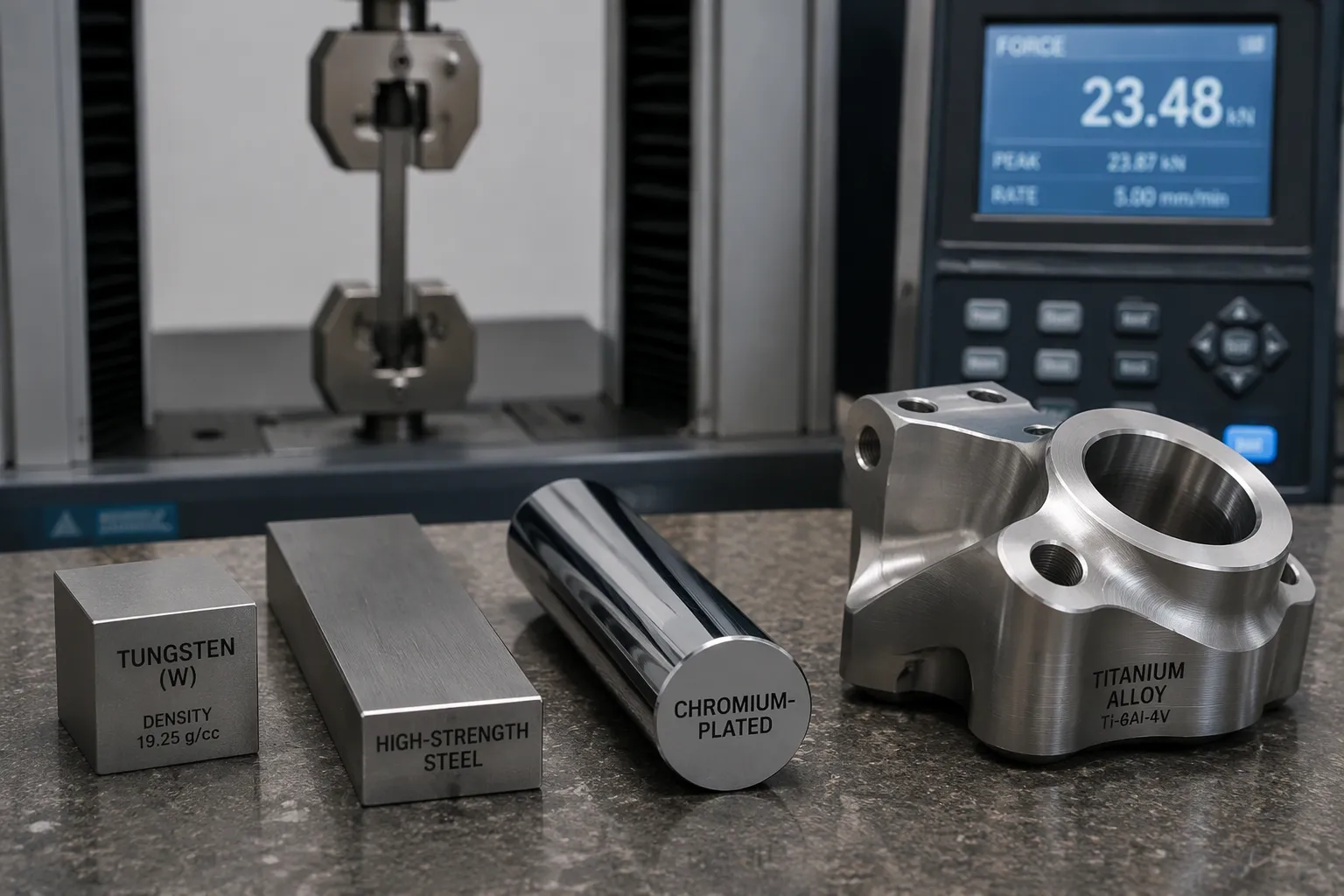
If you measure pulling force, tungsten takes the crown among pure metals. This strongest pure metal carries roughly 980 to 1725 MPa of tensile strength and about 750 MPa of yield strength at room temperature. That combination makes tungsten the strongest metal by tensile strength in its pure form. Nothing else in the pure-metal column comes close on absolute pulling power.
Alloys change the picture. High-strength steels lead the alloy class on both tensile and yield strength. PartMfg reports that tool steels can exceed 2,000 MPa in tensile strength. Titanium alloys sit lower on absolute numbers but stay competitive. The table below, drawn from Haoyu Material, shows where each family lands.
Material Grade | Yield Strength (MPa) | Ultimate Tensile Strength (MPa) |
|---|---|---|
Commercially Pure Titanium (Grade 2) | 275 | 345 |
Ti-6Al-4V Alloy (Grade 5) | 880 | 950 |
High-Strength Steel (4130 Annealed) | 460 | 560 |
So what is the strongest metal on earth and why? For raw tensile and yield strength, tungsten wins among pure metals and high-strength steels win among alloys. That is your first category answer.
Hardness gives the crown to a different winner. Chromium scores 8.5 to 9 on the Mohs scale, according to Monroe Engineering. Pure iron sits near 4 to 4.5, so chromium is nearly twice as hard. That hardness explains why chromium plating resists wear so well. Tungsten carbide, a compound rather than a pure metal, also earns attention in wear applications.
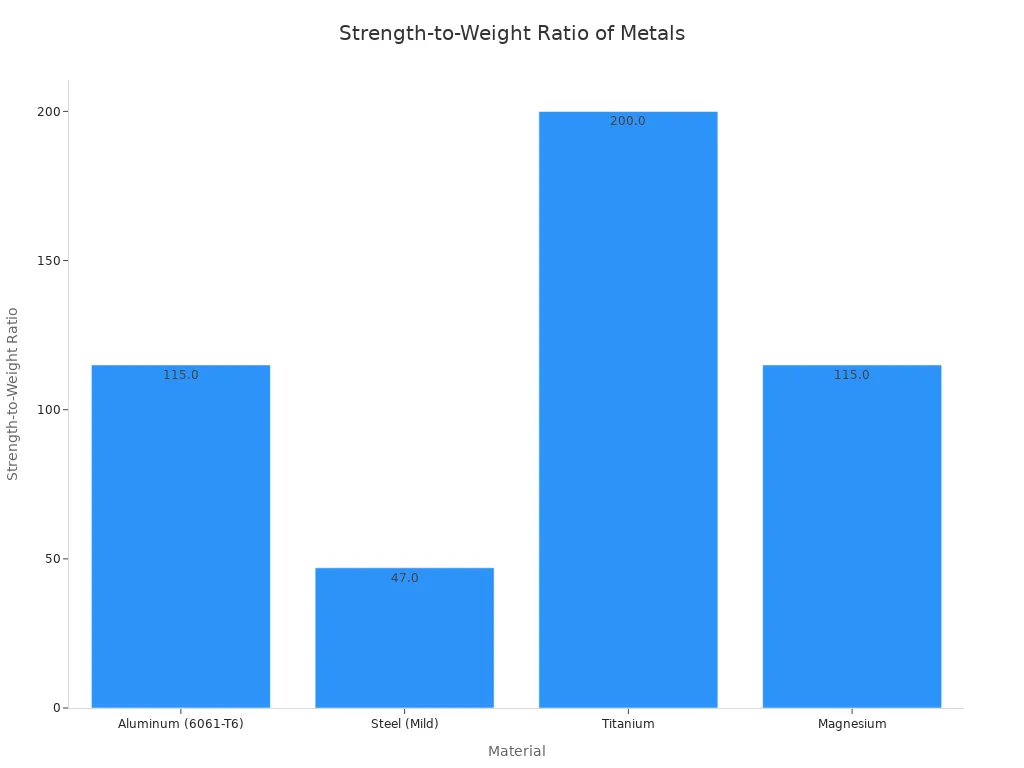
Strength-to-weight flips the ranking again. Titanium alloys lead here. Yajialuminum lists titanium at a strength-to-weight ratio of 200, against 115 for 6061-T6 aluminum and 47 for mild steel. Grade 5 titanium also beats common 6061 and 7075 aluminum bar conditions on overall strength-to-weight, per Forte Metals. For a given strength target, a titanium part can usually weigh less than an equivalent aluminum part.
Impact strength depends heavily on toughness and heat treatment, so no single metal owns that category outright. The strongest metals in the world each hold one title, not all of them. Tungsten wins tensile, chromium wins hardness, titanium wins strength-to-weight, and steel alloys win all-around tensile and yield performance. The strongest type of metal depends on which column you read.
A side-by-side view makes it much easier to compare the strongest metals and alloys. Each column below comes from Chiggo Factory, Morecambe Metals, and Sincere Machining, so you can see the category winners in one place.
Metal | Tensile Strength | Hardness | Strength-to-Weight Ratio |
|---|---|---|---|
Tungsten | up to 1,725 MPa | N/A | N/A |
Titanium (Ti-6Al-4V) | N/A | high; density of 4.43 g/cm³ | |
Chromium | N/A | 8.5 to 9.0 on the Mohs scale | N/A |
Stainless steel | yield strength up to 1,560 MPa; ultimate tensile strength up to 1,600 MPa | N/A | N/A |
The empty spots matter just as much as the numbers. Tungsten wins the pulling contest, but the table shows no hardness or weight figure for it. Chromium wins on scratch resistance, yet its tensile data stays blank. That is the whole point of this comparison of strongest metals and alloys: no row fills every column.
You do not need a materials degree to read these values. MPa means megapascals, which is a unit of pressure. One megapascal equals one newton of force spread over one square millimeter. A higher MPa number means the metal holds more load before it fails. So tungsten at up to 1,725 MPa out-pulls stainless steel at up to 1,600 MPa, though the gap is small.
Mohs values work in a different way. Wikipedia describes the Mohs scale as a qualitative ordinal scale from 1 to 10, ranked by which mineral scratches which. The steps are not even. Corundum at 9 is twice as hard as topaz at 8, and diamond at 10 is about four times as hard as corundum in absolute terms. Chromium's 8.5 to 9.0 score therefore points to serious wear resistance, not a steady jump over softer metals. For true hardness, labs use Vickers or Brinell indentation tests and report results in MPa, per Rubblerock and Gem. Those tests give you a quantitative mechanical properties reading that the Mohs scale cannot.

Your project decides which metal works best. Start with aluminum. The 7xxx series is great for aircraft. Alloy 7075 is used in aircraft structural parts and fasteners, and 7050 is used for thick-section forgings for wing spars and bulkheads, according to hts-alu.com. The 8xxx series is used in electronics, where conductive strip helps electronic applications. For construction and decoration, the 3xxx series is a good choice; 3105 covers window blinds, building facings, and lighting fixture housings. Cookware makers often use the 4xxx series, because heat-resistant strip works well for cooking surfaces.
Copper alloys cover electrical engineering in much the same way. C110 ETP copper gives about 100% IACS conductivity, per source21.com, which makes it a natural fit for bus bars, connectors, and power distribution parts. Brass such as C36000 offers full machinability for high-volume turned fittings, per makerstage.com. Ultra-thin copper alloy foil is used in circuit boards, high-purity copper strip supports electrical engineering, and electrolytic copper busbar fits switchgear systems.
Now think about the practical side. Weight matters most in flight, so 7xxx aluminum earns its place in aviation through a high strength-to-weight ratio. Cost and workability pull in other directions. C110 copper costs less than C101 and stays widely stocked, per makerstage.com, which helps when you buy in bulk. Brass machines fast, so it cuts cycle time on turned parts. Steel alloys remain the versatile workhorse for general structural work, and their strength covers many load cases at modest cost.
Regulatory compliance also shapes the pick. Food-contact and packaging jobs call for alloys suited to those uses, such as 8021 foil for pharmaceutical packaging. Electrical work demands proven conductivity, which is why high-purity copper strip and electrolytic busbar stay in demand. Compare options on performance, fit, compliance, and cost together. Each material wins somewhere.
The honest answer has two parts. Titanium alloys win on strength-to-weight ratio. Steel alloys win on absolute tensile strength and yield strength. Metals Supermarkets says it simply: titanium gives you more strength per unit of mass, but steel is still the better choice for total strength.
Weight tells the story. At equal volume, titanium weighs about 43% less than typical steel, according to AZ Metals. That gap explains why titanium shows up in aerospace parts, prosthetics, surgical tools, tennis rackets, and motorsports components. A lighter part means less load on everything around it.
Steel takes the other crown. Makerstage lists where steel pulls ahead of Ti-6Al-4V:
Application condition | Steel advantage over titanium |
|---|---|
Ultra-high absolute strength needed (above 1,034 MPa) | 4340 HT, 300M, and Aermet 100 reach 1,241–2,068 MPa UTS |
Operating temperature above 315°C | 4340 and H-11 steels run to 800–1,000°F+ in suitable tempers |
Wear resistance critical | Hardened steel at 58–62 HRC beats titanium's ~38 HRC ceiling |
Cost is the main driver | Steel costs 5–10× less per part |
Magnetic properties required | Titanium is non-magnetic; many steels are ferromagnetic |
So which one should you pick? Start with your load case and your weight budget. If the part must survive extreme pulling force, steel alloys give you headroom titanium cannot match without specialty grades. If every gram counts, titanium earns its higher price through weight savings and corrosion resistance in salt water and chemical processing.
Cost rarely decides alone. AZ Metals notes titanium is the better choice despite its higher cost when you need an excellent strength-to-weight ratio, exceptional corrosion resistance, and specialized installations. Steel stays the logical pick when only strength matters.
Neither metal wins everywhere. Frame the question around your application, and the right answer appears on its own.
So what is the strongest metal? You now know the answer depends on your job, not a single label. Tungsten handles extreme tensile demands. Titanium suits weight-sensitive designs. Chromium fights wear. Steel alloys stay versatile all-rounders. These strongest metals each win their own contest.
Before you choose, define your own strength requirement. Ask about load type, weight limits, budget, and environment. That checklist turns a vague question into a clear pick. The strongest metal in the world is the one that fits your part. Every metal here has a place where it performs best.
Tungsten wins on tensile strength among pure metals, at roughly 980 to 1725 MPa. It does not win every category, though. Chromium beats it on hardness, and titanium alloys beat it on strength-to-weight ratio. So tungsten holds one title, not all of them.
No. Hardness only tells you how well a surface resists scratches and wear. A hard metal can still be brittle. Chromium scores 8.5 to 9.0 on the Mohs scale, yet that number says nothing about how it handles pulling or impact. Match the metric to your load.
Start with titanium alloys when weight matters most. They lead on strength-to-weight ratio, so a titanium part can hit your strength target at lower mass. If absolute pulling strength matters more than grams, high-strength steels give you more headroom.
You can't. One figure hides how a metal behaves under sudden impact, wear, or repeated cycles. Ask what your part must survive first. Load type, weight limits, budget, and environment narrow the field faster than any single MPa value.
They measure different things. Pull on a sample and tungsten or high-strength steel wins. Scratch it and chromium wins. Weigh strength against density and titanium wins. That is why what is the strongest metal in the world depends on your application, not a label. The strongest metal on the earth is the one that fits your part, and the strongest metal on the earth for one job may lose on another.


