
English 
T: +86-571-8663-6649
E: hzbjys@hzbjys.com
E: hzbjys@hzbjys.com
7/F, 1st Building Of ZhongHao WangJiang International Center, NO.332 East WangJiang Road, HangZhou, ZheJiang, China.
Views: 0 Author: Site Editor Publish Time: 2026-10-21 Origin: Site


A homeowner is planning a backyard fence. A metalworker gives a price for a kitchen worktable. Both face the same choice: galvanized steel or stainless steel? The main difference is simple. Galvanized steel is carbon steel covered with zinc. Stainless steel is a steel mix that has at least 10% chromium. That one difference drives every key debate, from rust and strength to cost, building, and food-safety rules. Buyers weighing galvanized steel vs stainless steel soon learn that each metal fits different jobs. The same idea applies elsewhere: shoppers ask will brass rust, or whether a copper sheet or tinned copper busbar fits their build. So which metal fits the project, the budget, and the setting? Choosing between stainless steel and galvanized steel starts with that question.
Galvanized steel has a zinc coating that protects the metal by wearing away first.
Stainless steel has chromium built into the metal, so its protection regrows after a scratch.
Galvanized steel costs less and is easier to shape, making it good for mild outdoor jobs.
Stainless steel costs more upfront but lasts longer in harsh settings like coastal areas or food plants.
Choose the metal that fits your project's environment, budget, and lifespan, not just the price tag.
Galvanized steel begins as regular carbon steel. During the galvanizing process, workers dip that steel into a bath of melted zinc. The zinc sticks to the surface and forms a protective zinc layer. This layer works as a shield against the outside world. It also gives itself up. When rust attacks, the zinc corrodes first and keeps the steel underneath safe. That is why the coating is called a sacrificial coating.
The galvanized steel composition stays simple. The base metal is still carbon steel, and only the surface changes. Hot-dip galvanizing makes hot-dip galvanized steel with a thick, even zinc coat. This method works well for outdoor jobs like fences, guardrails, and roofing. The coating does have one limit. A deep scratch or cut can uncover bare steel, and rust may begin at that spot.
Stainless steel is an alloy, not a coated product. Its stainless steel composition includes iron, carbon, and at least 10% chromium. The chromium makes the difference. It reacts with oxygen in the air and builds a thin chromium oxide layer on the surface. This passive layer seals the metal from moisture and air. Unlike a zinc coat, the protection runs through the whole material. A scratch does not remove it, because the layer grows back on its own.
That built-in defense explains why stainless steel resists corrosion in harsh settings. Coastal air, chemicals, and constant moisture test most metals. Stainless steel handles these conditions with much less maintenance. The trade-off is price and workability, which later sections cover. For now, the key point is clear. Galvanized steel vs stainless steel comes down to a surface coating versus a change inside the metal itself.
A table makes the galvanized steel vs stainless steel question easy to see. Readers can look down the rows and find where each metal does best.
Factor | Galvanized Steel | Stainless Steel |
|---|---|---|
Corrosion resistance | Good in mild, humid, and indoor settings; the zinc layer gives itself up | Excellent; the chromium oxide layer renews itself |
Strength | Solid for structural work; the base carbon steel sets the limit | Generally stronger and tougher |
Cost | Lower upfront; the zinc dip is a simple, low-cost step | Higher upfront; pays back over a long service life |
Ductility and workability | More ductile and easier to form | Harder to cut and bend |
Weldability | Weldable; the zinc coat needs care and removal at the joint | Weldable with the right filler and technique |
Aesthetics | Dull gray finish that weathers over time | Shiny, silvery look that holds up |
Best-fit applications | Fencing, guardrails, roofing, ductwork, outdoor frames | Kitchen equipment, medical tools, coastal hardware, chemical plants |
The pattern is easy to see. Galvanized steel costs less and is easier to work with. Stainless steel gives you more strength and durability, plus much better corrosion resistance. Neither metal is a bad choice. Each one just fits a different set of needs.
Looking at cost alone only tells half the story. A short-term outdoor project in a mild climate often works well with galvanized steel. A long-lasting part in salt air or a wash-down zone is better with stainless steel. This full comparison shows that galvanized vs. stainless is about matching the material to the job, not a contest with one winner.
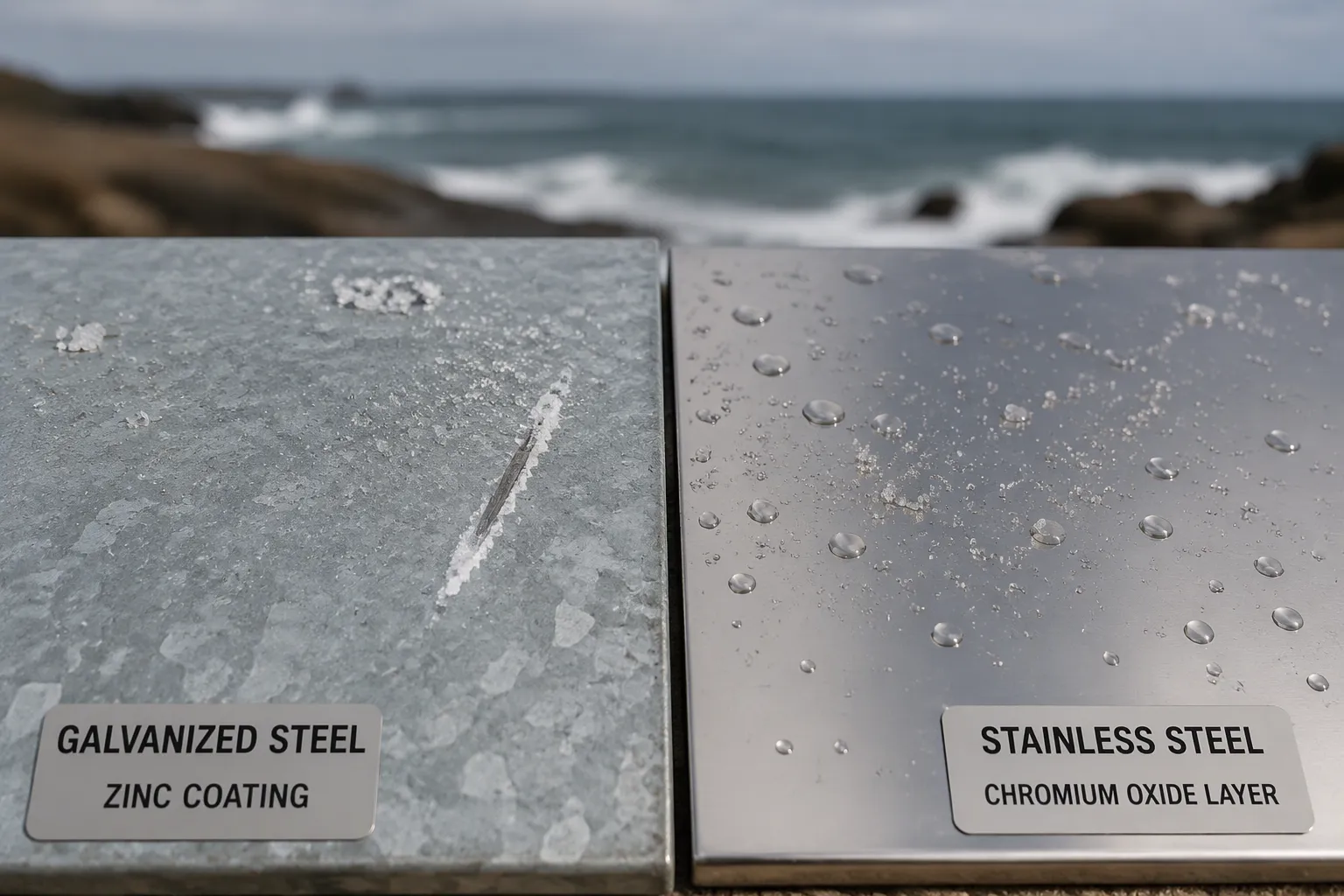
Water, salt, and air cause most metal to break down. Galvanized steel and stainless steel fight corrosion in different ways, not just by different amounts. One metal depends on a coating that uses itself up. The other carries its protection all the way through. That difference shapes every choice about where each product belongs. It also explains why two panels that look alike act so differently after a few seasons outside.
To see how galvanized steel resists corrosion, start at the surface. A zinc layer keeps oxygen and water from reaching the carbon steel below. The zinc also gives itself up first. Norck explains that even a scratched surface keeps some protection, because the zinc corrodes in place of the metal beneath it. Zinc oxide and zinc carbonate build up and add a second barrier. This system works well against water and chlorine, as Unified Alloys notes. It has one weak point: the layer does not heal.
To see how stainless steel resists corrosion, look inside the alloy. Chromium reacts with oxygen and forms a chromium oxide layer on the surface. Eureka Patsnap describes this film as only nanometers thick, and it regrows on its own whenever oxygen is present. Grades such as 304 and 316 last well, and 316 adds molybdenum for better resistance to chloride pitting. The protection survives a scratch, so rust has a much harder time taking hold.
The environment decides which metal earns its place, and corrosion resistance sets the ranking. Action Stainless lays out the pattern clearly.
Environment | Galvanized Steel | Stainless Steel |
|---|---|---|
Coastal or salt exposure | Struggles in wet, humid air; corrosion speeds up as the zinc wears | Outperforms consistently; 316 grade suits marine and chloride-rich sites |
Chemical exposure | Struggles in aggressive settings as the coating wears | Outperforms consistently; 316 grade handles chemical and chloride-rich sites |
Continuous moisture | Adequate when dry or mildly corrosive; struggles when always wet | Holds up over long periods, including washdown zones |
Atlantic Stainless reports that saltwater drives corrosion five times quicker, and seawater up to 10 times, since it also carries bacteria that consume iron. Tropical seawater speeds decay further. A humid room, an indoor frame, or a mild outdoor fence fits easily within galvanized steel vs. stainless steel budgets, and the zinc option usually wins there. Coastal decks, chemical plants, and wash-down rooms flip the answer. Stainless steel vs galvanized steel becomes an easy call in those settings, because stainless steel’s corrosion resistance holds up where the zinc coat fades. Avanti Engineering notes that stainless steel and galvanized steel each serve different needs, with the alloy chosen for harsh sites and the coated metal for cost-sensitive work.
Damage matters too. A deep scratch in the zinc on galvanized steel leaves bare metal exposed, and decay can start at that spot. The passive film on stainless steel regrows instead. That difference explains why the alloy lasts longer in tough conditions.
Stainless steel usually has more strength than galvanized steel. Jake Sales reports that stainless steel often has a tensile strength of 100,000 to 150,000 PSI. This depends on the grade and heat treatment. Standard galvanized fasteners reach about 62,000 PSI. That gap matters for heavy loads and long service.
Material | Typical Tensile Strength |
|---|---|
Stainless steel | 100,000 to 150,000 PSI (depending on grade and heat treatment) |
Galvanized steel | approximately 62,000 PSI (for standard galvanized fasteners) |
Galvanized steel still gives solid strength and durability for structural work. The zinc coating changes the surface, not the carbon steel underneath. A builder who picks galvanized steel gets the same load capacity as the bare steel core. The coating just adds protection from the elements.
Ductility sets the two metals apart in the shop. Galvanized steel bends and forms more easily, so fabricators shape it with less effort. Stainless steel resists deformation and holds its shape under load. Each trait fits a different task.
Heat tests both metals in different ways. Stainless steel keeps its structure at high temperatures, which suits cookware, exhaust parts, and process equipment. Galvanized steel does well in everyday conditions, but the zinc layer has limits. Very high heat can damage the coating and leave the base metal exposed.
Stress shows another contrast. Stainless steel handles repeated loading and harsh conditions without losing its edge. Its corrosion resistance stays intact even after wear. Galvanized steel relies on how galvanized steel resists corrosion through its zinc barrier, and that barrier wears down over time. Buyers who compare how stainless steel resists corrosion with the zinc approach see the trade-off clearly. One metal protects itself from within, and the other depends on a surface layer. Both approaches work, and the setting decides which one lasts.
The price tags for the two metals are different right away. Wanzhi Galvanized reports a big gap in raw material prices per ton.
Material | Price per ton |
|---|---|
Galvanized steel | 600-800 USD per ton |
Stainless steel | 1000-2000 USD per ton |
Galvanizing is a simple dip process that does not cost much. That keeps the price of hot-dip galvanized steel low. Metalcraft Spinning notes that stainless steel can cost about five times more than the coated option. Labor follows the same pattern. Workers form and install the zinc-coated product with less effort, so both materials and labor stay affordable. Most projects find the coated metal the cheaper pick upfront.
A low purchase price does not always mean a low total bill. Hongtengtop compares the two metals over a full service life. Indoor industrial tubing in the zinc-coated version lasts 20–25 years, while 316 stainless lasts 40 or more. Salt spray testing under ASTM B117 shows 120–200 hours for the coated tubing against 1,500+ hours for the alloy. Coastal sites need maintenance every 2.1 years on the coated product, and the alloy needs none within 10 years. A 25-year total cost model puts the coated tubing at $128,400 per kilometer and stainless at $119,700 per kilometer. The alloy saves $8,700 per kilometer even though it costs more at the start.
Higher capex (initial investment)
Lower opex (maintenance and replacement)
For example, in coastal infrastructure projects, switching to stainless steel may reduce replacement cycles from 5 years to over 25 — a huge operational saving over time.
That trade-off deserves a calm look, not a quick verdict. A short project in a mild climate favors the cheaper metal. A long service life in salt air or chemical exposure favors the alloy. This cost comparison works best when buyers match the choice to project lifespan and setting.
The zinc-coated metal bends and shapes more easily than the alloy, so fabricators can form it fast. Welding brings a different set of challenges. Hobart Brothers notes that hot-dipped galvanized material is the hardest type to weld, and it stays the most common because it costs less. The zinc turns to vapor at a much lower temperature than steel, so gas pockets can get trapped inside a weld pool that freezes fast. Porosity and worm tracking result, and a joint can look clean on the surface while hiding defects underneath.
Safety planning matters as much as technique. The American Galvanizers Association advises making welds on zinc-free areas, so workers grind the coating back to bare metal before striking an arc. Dews Foundry warns that zinc oxide fumes can cause metal fume fever, with symptoms such as fever, chills, and nausea. Local exhaust ventilation near the weld captures fumes at the source, and a respirator supports that control. Workers should re-coat disturbed areas after the weld to restore corrosion protection.
The alloy resists cutting and bending, yet it rewards careful work with strong, clean joints. Filler selection decides the outcome. Klöckner Metals explains that the filler grade needs to match the base material's grade, and wire diameter usually runs .030 inches, with .035 to .045 inches for thicker pieces. TIG suits thin material and precise, attractive welds. MIG produces solid, reliable welds on thick sections.
Shielding gas and technique complete the picture. Klöckner Metals recommends a mixture of 7.5% argon, 90% helium, and 2.5% carbon dioxide rather than a pure inert gas. For TIG work, a DC electrode negative setting with 1 amp per 1/1000-inch of thickness gives a practical starting point. MIG welders use the push technique for visibility and less beading. Unified Alloys cautions against pairing a high-carbon filler such as 316H with a low-carbon base like 316L. Matching the filler to the base grade keeps corrosion resistance intact along the joint.
Looks matter to many buyers, and the two metals age in different ways. Seather Technology describes stainless steel as shiny and silver, with a finish that stays nice even in hard places like cities near the ocean. The shine holds because the metal does not rust easily. Galvanized steel looks dull and gray by comparison. Its zinc coat stops rust, yet the surface can start to look patchy or faded.
Weathering changes the picture in an interesting way. Sisttemex Hot-Dip Galvanizing notes that a change in appearance does not necessarily signal a change in protection. The atmosphere gradually develops the zinc surface, and this process reduces initial differences in appearance. Over time, the coating settles into a more uniform matte gray finish.
Material | Appearance over time |
|---|---|
Stainless steel | Shiny and silver; the finish stays nice even in hard places like coastal cities; keeps its shine because it does not rust easily |
Galvanized steel | Dull and gray; the zinc stops rust but can look patchy or faded |
Both metals accept extra finishes, and the options differ. CBS Sheet Metal lists several routes for coated steel, including Galvalume, a galvanized finish for corrugated roofing and siding, and a Kynar painted finish. Paint gives the dull gray surface a new color, and proper prep helps it bond. Stainless steel offers its own menu, per Metal Supermarkets. A No. 2B matte finish is the mill finish, dull and the least expensive option. A No. 4 brushed finish creates a muted luster with fine parallel lines and strong decorative appeal. A No. 8 mirror finish is highly reflective and improves corrosion resistance by eradicating crevices.
These choices come down to personal taste and project goals. Some people love the bright, silvery look of polished alloy. Others prefer the low-key gray of a coated panel or the color of a painted roof. Neither look is better in any objective sense. Aesthetics remain a preference factor, and the setting, budget, and maintenance plan should guide the final pick.
Food plants, hospitals, and drinking-water systems all share one demand: surfaces must not contaminate the product. Materials must pass extraction tests and resist the cleaning and sanitizing chemicals common in food plants. They also must not impart odor, flavor, or harmful substances to the product stream, according to Vanguard Products. A surface that traps residue or breaks down under cleaners fails this test, no matter how strong it is.
Several standards govern these rules. Each one covers a different part of the chain.
Standard | Scope and Requirements |
|---|---|
FDA 21 CFR 174–181 | Indirect food additives and prior-sanctioned ingredients |
NSF/ANSI-51 | Food equipment materials; must not contaminate food or make equipment hard to clean and sanitize |
NSF/ANSI-61 | Drinking water system components; tests for contaminants that may leach into water |
3-A Sanitary Standards | Dairy and perishable-food equipment; must resist steam sterilization, milk fat, acid and alkali cleaners, and chlorine sanitizers |
NSF/ANSI-51 and NSF/ANSI-61 both require third-party certification with independent testing and periodic facility audits, Vanguard Products notes. A supplier's claim alone does not satisfy either standard.
Stainless steel is the usual choice for food-contact and medical settings. Its cleanable, non-porous surface resists bacterial growth and does not leach harmful ions, Langhe Metal reports. Grades 304 and 316 deliver hygienic surfaces that resist organic acids and allow frequent clean-in-place cycles without damage. That built-in corrosion resistance explains the preference. The protection runs through the whole material, so a scratch does not open a path for corrosion.
Galvanized steel is generally not recommended for direct food contact. Zinc can leach into food, especially acidic items, per Langhe Metal. The zinc coating may also react with acidic foods and cleaning agents. A coated panel can still serve well for structural frames, shelving supports, or ductwork that never touches the product.
Neither rule is absolute for every setting. Local health codes vary by region and application. Buyers should confirm the exact standard their project must meet before ordering, and check with local authorities for specific requirements.
Galvanized steel works well for jobs where cost matters and the setting stays mild. SendCutSend lists fencing and gates as a natural match, since the zinc coat keeps them rust-resistant with little upkeep. Roofing and wall cladding also rely on this metal, because panels face sun and rain every day. Ductwork and HVAC systems use it to resist rust and keep air quality clean. Builders also choose hot-dip galvanized steel for guardrails, utility poles, and transmission towers, where the coating protects power and communication lines.
Agriculture and energy add more uses. Worthington Steel notes that farms use the metal for grain bins and irrigation systems that withstand all weather. Solar racking and ground mounts also depend on it for weather protection. South Atlantic LLC points to handrails, canopies, and solar panels as everyday outdoor structures. The writer's company supplies multiple metal options, and this coated product remains a valid fit for these cost-sensitive, mild-environment jobs.
Stainless steel serves settings that demand hygiene or harsh-condition durability. Wikipedia's list of applications notes that Types 304 and 316 handle potable water, wastewater treatment, and desalination. Food and beverage plants favor the 300 series for cookware, commercial kitchens, brewing, and meat processing. General Steel reports that dairies use it in milking equipment and storage tanks, while medical settings rely on it for surgical instruments. Its non-porous surface allows easy sterilization.
Chemical and marine work also depend on the alloy. AZOM notes that 316L serves marine applications, chemical screens, and oil refineries. Pulp and paper plants use duplex and superaustenitic grades to resist papermaking chemicals. The same corrosion resistance that suits these plants also protects coastal hardware. Both metals earn their place, and the writer's company supplies each one for the jobs it handles best.
Galvanized steel earns its place through price and ease of use. The hot-dip process is cheap and fast, and it coats simple and complex shapes alike, according to National Material. The zinc layer fights rust in two ways. It blocks moisture and oxygen, and it gives itself up first when damage occurs. IQS Directory notes that the zinc corrodes before the steel does, so a scratch does not ruin the part. The metal also bends and forms more easily than many alternatives, which speeds up cutting and installation. Sheffield Metals points out one more plus: a ventilated galvanized roof system performs well in animal confinement buildings.
The drawbacks center on the coating. Zinc wears faster under frequent rain or salt water, so IQS Directory advises regular checks in those settings. A deep scratch that exposes the core invites red rust, and Sheffield Metals warns that the rust spreads rather than stops. Poor cooling during processing can make the zinc peel or chip. National Material also sets a heat ceiling: the coating holds up to 392 °F, and higher temperatures cause the zinc-carbonate layer to peel. Most manufacturers offer no warranty on the substrate, Sheffield Metals adds.
Stainless steel brings strength, hygiene, and staying power. Space Coast Daily describes it as easy to maintain, since mild soap and water keep the surface clean and shiny. The material resists corrosion, holds its structure in extreme temperatures, and does not absorb liquids. Topson Stainless lists heat resistance, versatility, and full recyclability among its strengths. These traits explain its role in kitchens, medical tools, and coastal hardware.
The costs are real, though. Stainless steel carries a higher upfront price because of alloying elements such as chromium and nickel, per Topson Stainless. It can still stain or corrode under chloride exposure or harsh chemicals, so regular cleaning matters. Space Coast Daily notes that dents and scratches remain possible without careful handling. Topson Stainless adds that the metal is heavier than some alternatives and harder to machine, since it work-hardens during cutting. Neither list makes one option the loser. The galvanized vs. stainless choice simply matches strengths to the job.
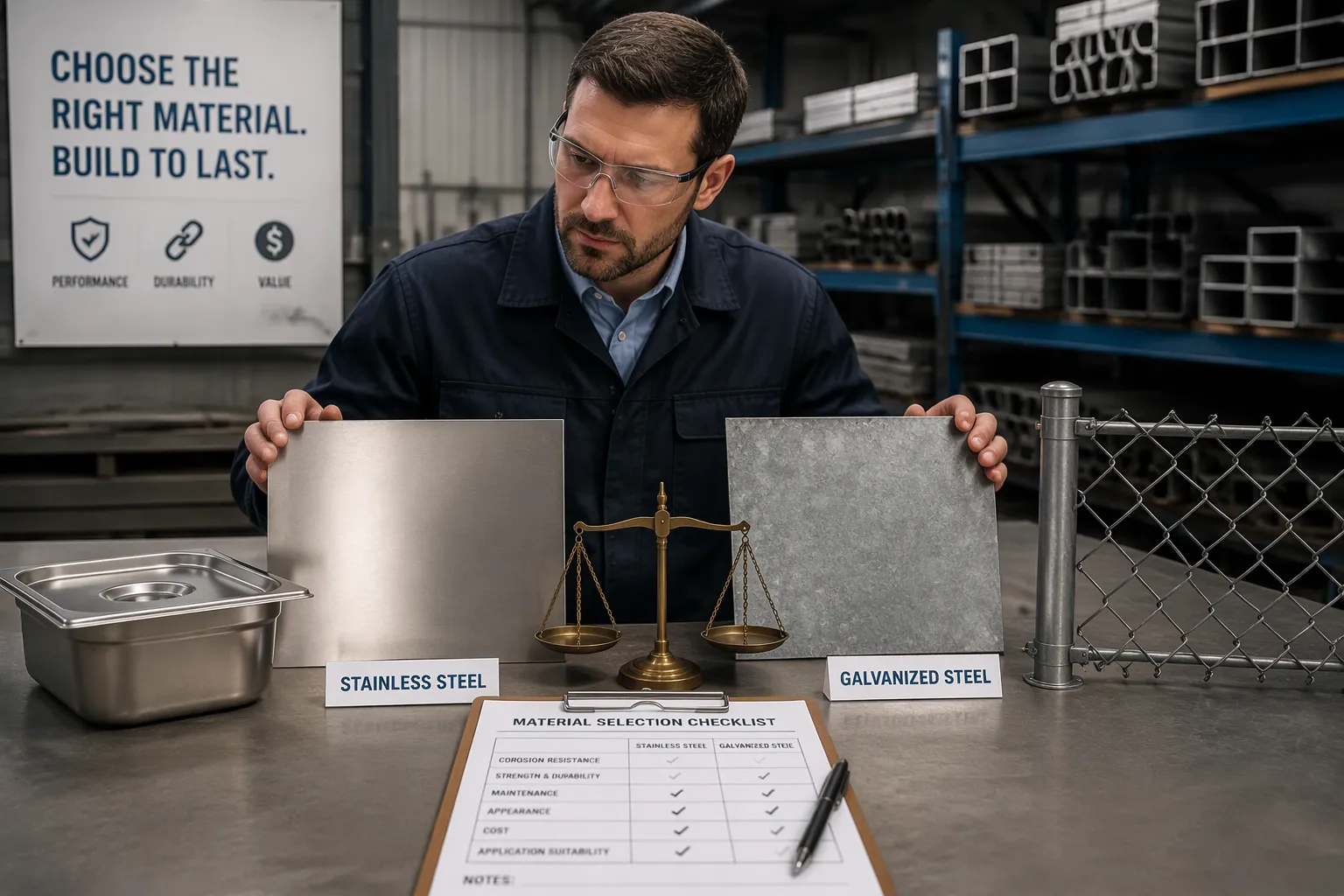
A good choice starts with a short list of questions. Avanti Engineering says buyers should think about rust resistance, strength, how easy the metal is to shape, cost, and upkeep before they decide. Each question below turns those factors into a simple check.
What will the part face? Humidity, salt spray, and chemicals all put more stress on the metal. Avanti Engineering notes that stainless steel handles harsh settings best, because its surface heals itself.
How long must the part last? A frame that lasts a short time and one that lasts decades need different budgets.
What is the spending limit? Galvanized steel is the budget-friendly pick when cost and flexibility matter most, per Avanti Engineering.
Does appearance or cleanliness matter? Shiny finishes and food-contact rules point one way, and a painted gray panel points the other.
How much shaping is required? Cutting, bending, and welding work affect both the schedule and the final bill.
Ram Steel adds a helpful rule of thumb. The zinc coating on galvanized steel protects the surface, and damage from welding, cutting, or heavy scraping can expose bare metal. Stainless steel carries its chromium protection inside the metal itself. That one difference answers many of the questions above.
Matching a material to a job works better than ranking the two metals. Seather Technology maps common projects to a clear fit. Kitchen equipment, medical tools, and coastal structures favor stainless steel for easy cleaning, germ resistance, and salt tolerance. Outdoor fencing and roof panels favor galvanized steel for low cost and reliable rain protection. Seather Technology sums up the pattern well: pick the coated metal for outdoor jobs in mild conditions, and pick the alloy for wet, chemical, or high-visibility settings.
PaceSetter frames the same idea for industry. Construction, automotive, and manufacturing each reward a material matched to their own demands. A builder who needs affordable rain protection and a plant that needs wash-down hygiene both make good choices, just not the same one. This is the heart of choosing between stainless steel and galvanized steel: fit, not rank.
Readers can pair this guide with the comparison table earlier in the article. The table shows the traits side by side, and these questions turn the traits into a decision. Used together, they make choosing the right steel for your project a simple task. The environment, budget, lifespan, and shaping needs of the job point to the answer. Both galvanized and stainless steel remain valid options, and each one serves its own set of jobs well.
The main difference is still easy to see. Galvanized steel has a zinc coating that protects the metal by wearing away first. Stainless steel builds chromium-based protection right into the metal itself. That one difference shapes every trade-off in this guide.
Before ordering, buyers should think about four things. Environment, budget, lifespan, and how the metal will be shaped all matter more than the price tag alone. A cheap panel that fails early ends up costing more than a durable one.
The right tools make choosing between stainless steel and galvanized steel easier. The comparison table shows the traits side by side. The decision questions turn those traits into a clear answer. Together, they help any buyer match the right steel to the job.
Service life depends on the setting. The article notes that zinc-coated tubing indoors lasts 20–25 years, while 316 stainless lasts 40 or more. Salt air and constant moisture shorten the coated product's life. Buyers should match the expected lifespan to the project.
Yes. Paint gives the dull gray surface a new color, and proper prep helps it bond. The article lists Galvalume and Kynar painted finishes as options for coated panels. A painted panel suits roofing and siding well.
No. Each metal fits different jobs. The alloy costs more upfront and resists cutting and bending. The coated option costs less and forms more easily. A mild, budget-sensitive project often favors galvanized steel, while harsh settings favor the alloy.
Yes. The article states the coating holds up to 392 °F, and higher temperatures cause the zinc-carbonate layer to peel. Stainless steel keeps its structure at high temperatures. Buyers facing hot service conditions should weigh that limit carefully.
Yes. A deep scratch in the zinc leaves bare steel exposed, and rust can start there. Stainless steel regrows its passive layer instead. That difference matters in wet or salty settings.


