
English 
T: +86-571-8663-6649
E: hzbjys@hzbjys.com
E: hzbjys@hzbjys.com
7/F, 1st Building Of ZhongHao WangJiang International Center, NO.332 East WangJiang Road, HangZhou, ZheJiang, China.
Views: 0 Author: Site Editor Publish Time: 2026-11-05 Origin: Site


To answer what is steel made of: steel is an alloy made mostly of iron with a small amount of carbon, roughly 0.02% to 2.1%. Think of a recipe. The base metal is the main ingredient, and carbon is the seasoning. A pinch of seasoning changes the whole dish, and a pinch of it changes the whole metal. A mixture of elements where at least one is a metal behaves differently from its pure parts. This simple explanation shows what each ingredient does and why tiny amounts matter so much. Other metals follow the same idea, including Aluminum Coil, Copper Sheet, and Brass Strip.
Steel is mostly iron, with a little bit of carbon mixed in. The carbon usually makes up between 0.02% and 2.1% of the steel.
Carbon makes steel harder, but too much carbon makes it brittle, like cast iron.
Other elements, such as manganese and chromium, are added in small amounts to give steel special properties.
Steel is different from iron because steel has a set, controlled amount of carbon added to it.
Different kinds of steel, like carbon steel and stainless steel, use different recipes for specific jobs.
Steel is a mix of iron and carbon, and iron makes up more than 95% of it. Misumi reports that iron is about 98% of most carbon and tool steels, while stainless steel holds roughly 70% to 80%. That one fact answers what steel is made of in most real cases.
Iron is the base metal. Workers smelt it from iron ore, a rock full of iron oxides like hematite and magnetite, and refine it into concentrates that feed blast furnaces. Those furnaces turn the concentrates into the iron that becomes steel.
Iron gives steel its bulk, its strength, and its ability to carry load. It also takes in carbon easily. Hot iron absorbs more carbon as the temperature rises, so the melt stage sets up the final recipe.
Carbon is the hardening agent. The carbon content usually ranges between 0.02% and 2.1% by weight, and AZOM notes that above 2.1% the material becomes cast iron rather than steel. Service Steel adds that more carbon means more hardness and less ductility, so high-carbon grades cut and wear well but bend poorly.
Think of salt in bread dough. A small spoon changes texture; a large spoon ruins the loaf. The specific amount of carbon works the same way inside an iron-carbon alloy.
An alloy is a material made by combining a base metal with one or more additional elements to reach specific properties. Other alloy-based materials include aluminum, copper, and brass products, though none of them are ingredients in steel.
Iron and carbon make up the base of steel, but most types also have a few helpers. Manganese is the most common one, and it shows up at up to about 1%. Small amounts of silicon, phosphorus, sulfur, and oxygen also appear in typical melts. Each one adjusts traits like strength, hardness, and machinability, which means how easily a cutter shapes the metal.
PatSnap lists typical ranges for several alloying elements in low-alloy steel. The table below shows the main ones.
Element | Typical concentration range |
|---|---|
Vanadium | 0.01–0.35% |
Niobium | 0.005–0.1% |
Titanium | 0.005–0.05% |
Nickel | 0.3–4.0% |
Copper | 0.3–4.8% |
Boron | 0.0006–0.05% |
Chromium | 0.1% to 5.5% |
Molybdenum | 0.1–2.5% |
Weerg adds that free-machining steels use sulfur between 0.15% and 0.35%. Stainless steel needs at least 10.5% chromium. These numbers show how much the recipe can change.
Even tiny doses of these elements besides carbon change the metal in big ways. Total Materia explains that alloying elements work through phase control, carbide and nitride formation, and precipitation hardening. In simple terms, they guide how the crystal structure forms and how hard particles hold the metal in place.
Nickel and manganese favor one structure, while chromium and silicon favor another. Carbide formers such as chromium, molybdenum, and vanadium harden the steel. Aluminum or titanium at roughly 1.5% allows very high surface hardness through nitriding, per Total Materia. A boron level near 0.001–0.003% already shifts hardenability, PatSnap notes. So the composition of steel depends on careful dosing, not adding large amounts.
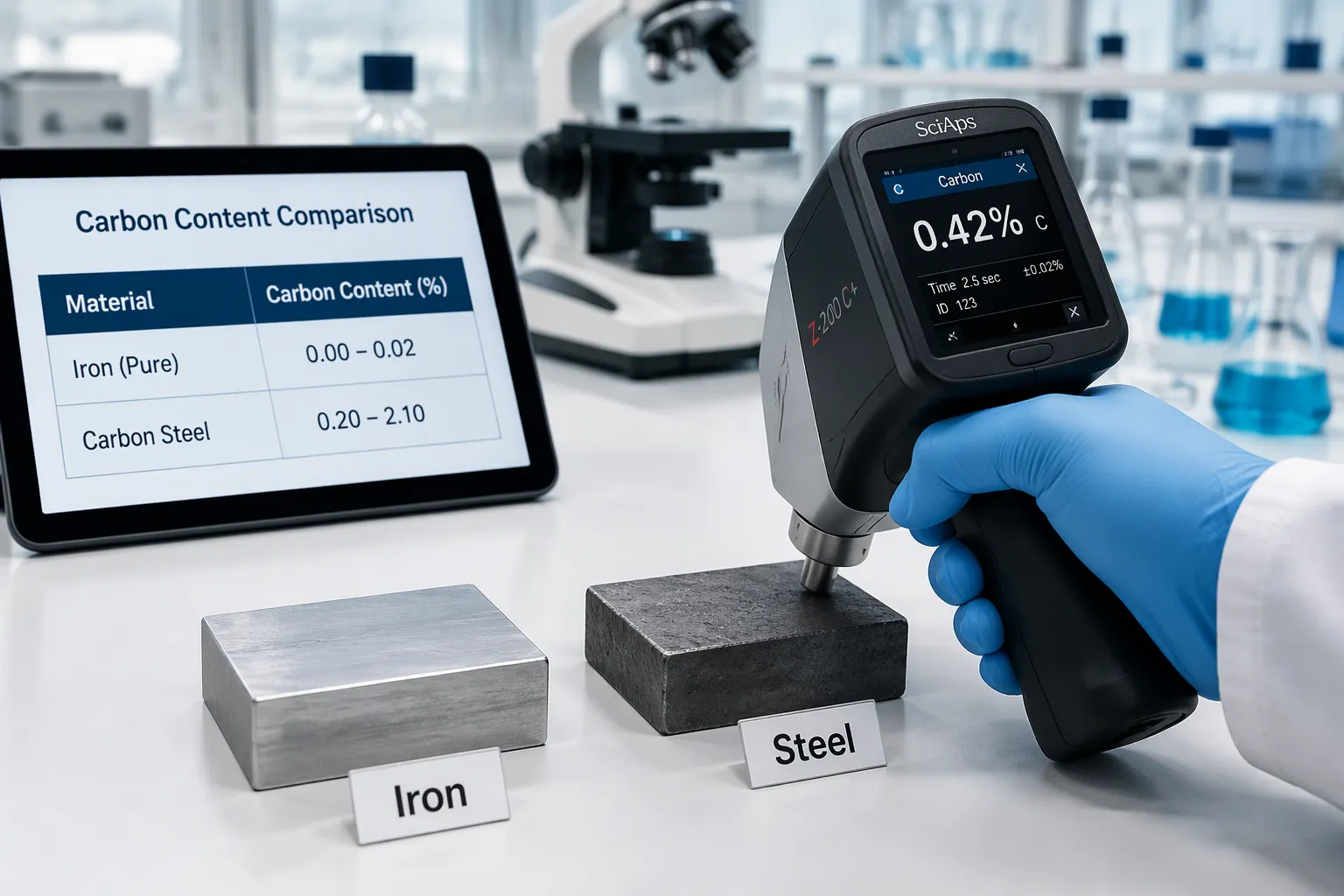
Iron is the base metal that workers get from iron ore by smelting. Steel is iron with a set amount of carbon added. That one step is what separates the two materials, and it explains most of the differences in how they act.
The amount of carbon is what tells the two materials apart. Eastern Steels lists pure iron at 0.02% carbon or less, wrought iron below 0.2%, and carbon steel from 0.02% to 2.1%. Cast iron and pig iron go higher, into the 2% to 4.5% range.
Material | Carbon Content |
|---|---|
Carbon Steel | 0.02% – 2.1% |
Pure Iron | ≤ 0.02% |
Wrought Iron | < 0.2% |
Cast Iron | 2% – 4.5% |
Iron ore itself holds no free metal. Smelting pulls the iron out of the ore, and the melt stage then sets the final carbon level. A tight carbon range keeps the mix predictable from batch to batch.
Carbon breaks up the crystal structure of iron, and Service Steel notes that this raises tensile strength, yield strength, and hardness. EconSteel describes steel as stronger and longer lasting, while pure iron stays softer and easier to bend. The properties of steel therefore depend on how much carbon is inside it.
Heat behavior shifts too. Service Steel puts pure iron's melting point near 2,800°F and steel's near 2,500°F, because carbon lowers the melting temperature. Pure iron also carries heat and electricity a little better, and it holds stronger magnetic properties. Steel resists rust better, especially in galvanized or stainless grades.
Neither material wins everywhere. Iron works well for decorative pieces, antique tools, and magnetic uses. Steel covers buildings, bridges, vehicles, and appliances, and its strength, ductility, and versatility keep it in demand. The right pick depends on the job, not on a ranking.

Four families cover most of the steel people meet. Markforged defines carbon steel as iron with some carbon and limited alloying elements. Grades such as 4140 count as alloy steel instead, because chromium and molybdenum drive their behavior. Stainless steel earns its name from high chromium content above 10.5% by mass and low carbon below 1.2% by mass. Tool steel sits at the hard end, with high carbon and carbide-forming additions.
The table below compares the typical makeup of each family, using figures from Misumi.
Type | Iron | Carbon | Chromium | Key Property |
|---|---|---|---|---|
Low Carbon Steel | 98% | 0.05% – 0.30% | < 0.30% | High Formability |
Medium Carbon Steel | 98% | 0.30% – 0.60% | < 0.30% | Increased Strength |
High Carbon Steel | 98% | 0.60% – 1.5% | < 0.30% | High Hardness |
70% – 80% | 0.05% – 1.2% | 10.5% – 30% | Corrosion Resistance | |
Tool Steel | 98% | 0.70% – 1.4% | 4.0% – 20% | Wear Resistance |
A metallurgist writing on LinkedIn splits carbon steels into three bands: low carbon up to 0.25%, medium carbon from 0.25% to 0.60%, and high carbon from 0.60% to 1.50%. Tool steel carries 0.5% to 1.5% carbon plus tungsten, molybdenum, vanadium, or cobalt. Wikipedia notes that the D2 grade holds 1.5% carbon and 11.0–13.0% chromium, while shock-resisting S grades keep carbon near 0.5% and gain toughness from 1–2% silicon and 0.5–1% molybdenum.
Each family fits a different job. Low carbon steel bends and welds easily, so it suits car bodies, pipes, and structural beams. Medium carbon steel adds strength for axles, gears, and machinery parts. High carbon steel holds a sharp edge, which makes it a natural pick for knives, springs, and cutting tools.
Stainless steel resists rust, so kitchens, medical instruments, and building facades rely on it. Tool steel takes the heaviest wear in dies, molds, and drill bits. The composition, elements, and types behind each grade explain these roles. A buyer who reads the chemical composition on a mill certificate can predict how a batch will behave. That habit turns the composition of steel from a lab detail into a practical guide.
Steel is iron with a small, carefully controlled amount of carbon, and makers often add other elements to get specific traits. That simple recipe answers what steel is made of. The makeup, especially the carbon level, separates the two materials and defines each type, from soft low-carbon sheet to hard tool steel.
A product label or mill certificate tells a buyer a lot about what is inside the metal. The listed numbers show how the metal will bend, cut, or resist rust. A quick look at the label turns a plain purchase into a smart choice about the right grade.
Steel is mostly iron with a small amount of carbon. Iron makes up more than 95% of the mix, and carbon usually falls between 0.02% and 2.1% by weight. Makers add other elements in small doses to fine-tune strength, hardness, or rust resistance.
Carbon acts as the hardening agent. More carbon raises hardness and lowers ductility, so high-carbon grades hold a sharp edge but bend poorly. A small change in the carbon level shifts the whole balance of the metal, much like extra salt changes a loaf of bread.
Manganese is the most common helper, at up to about 1%. Small amounts of silicon, phosphorus, sulfur, and oxygen also appear in typical melts. Stainless grades need at least 10.5% chromium for corrosion resistance. Each element adjusts traits like strength, hardness, and machinability.
Iron is the base metal smelted from ore. Steel is iron with a controlled amount of carbon added. Above roughly 2.1% carbon, the material becomes cast iron instead. Steel generally runs harder and stronger, while pure iron stays softer and more ductile.
No. Carbon steel relies on carbon alone for its properties. Alloy steel adds elements like chromium and molybdenum. Stainless steel leans on high chromium, and tool steel combines high carbon with carbide formers. The recipe defines the grade, and the mill certificate lists the exact numbers.


