
English 
T: +86-571-8663-6649
E: hzbjys@hzbjys.com
E: hzbjys@hzbjys.com
7/F, 1st Building Of ZhongHao WangJiang International Center, NO.332 East WangJiang Road, HangZhou, ZheJiang, China.
Views: 0 Author: Site Editor Publish Time: 2026-11-09 Origin: Site


Modern commercial and institutional projects are shifting away from disposable, coated envelope systems like PVDF-coated aluminum and standard carbon steel. We see a strong transition toward durable, self-healing copper alloys. The engineering problem lies in balancing high-end aesthetic intent with the harsh realities of structural loading, alloy metallurgy, unexpected patination, and galvanic isolation issues. You also have to justify the high initial capital expenditure without relying on basic lifecycle assumptions. This guide provides a technical, decision-stage framework. We designed it for architects, facade consultants, and structural engineers. You will learn how to evaluate copper-based alloys, select appropriate chemistries, and engineer failure-proof architectural assemblies. We cover everything from dead-load anchor detailing to managing thermal expansion across large facade spans.
Metallurgical Distinction Dictates Performance: Commercial "architectural bronze" (predominantly brasses such as C38500) differs fundamentally from engineering-grade tin, phosphor, and aluminum bronzes in yield strength, corrosion resistance, and workability.
Self-Healing Durability Lowers Lifecycle Costs: While initial material costs exceed standard envelope metals by 3x–5x, bronze alloys produce a protective cuprous oxide/carbonate patina that eliminates recoating costs and yields a 100+ year service life.
Galvanic Isolation is Non-Negotiable: Bronze ranks high on the galvanic scale (cathodic); failure to specify non-conductive isolation at steel or aluminum substructure interfaces leads to catastrophic galvanic acceleration of the framework.
Mass and Thermal Considerations: Bronze's density (~8.8 g/cm³) and distinct coefficient of thermal expansion require purpose-engineered dead-load anchors and slotted expansion joints to prevent oil-canning and structural deflection.
Inherent Fire Safety: As solid, non-combustible metals, true bronze materials meet stringent modern fire codes for high-rise facades without the need for fire-retardant cores.
Modern rainscreen design demands skins capable of handling severe cyclic wind pressures, solar radiation, and airborne salts. Thin composite panels and coil-coated aluminum sheets frequently develop micro-fissures around drilled holes and folded return flanges. On coastal sites, moisture penetration behind failing surface coatings prompts blistering and underfilm corrosion.
Solid-plate bronze architecture eliminates painted skin failure entirely. When fabricated into cassette panels or perforated shading louvers, solid plates resist permanent deformation from flying debris. They handle severe positive or negative wind pressures without buckling. Perforated solar screens cut from work-hardened plate retain flat geometric profiles over wide spans. The alloy forms a continuous, insoluble cuprous oxide barrier when exposed to ambient moisture. This prevents corrosive progression throughout the envelope.
Storefronts, monumental doors, and high-span curtain wall profiles experience significant physical abuse. Repeated impacts from public foot traffic, cleaning equipment, and hardware stress quickly scrape through standard anodized finishes. This exposes bare aluminum to oxidation. In large pivot doors, lightweight frame sections often warp under continuous thermal shock and heavy glazing weight.
Heavy-duty extrusions provide the stiffness and dimensional integrity needed for continuous storefront framing and oversized entrance leaves. Fabricators integrate high-density framing with structural polyamide thermal struts. This achieves thermal barrier breaks that match strict building energy codes. These assemblies deliver an authentic metallic finish with high surface hardness. They resist denting while handling massive multi-pane insulated glass units.
Inside commercial buildings, copper alloys serve both functional and hygienic purposes. High-traffic transition thresholds, grab bars, elevator jambs, and grand staircase balustrades endure continuous friction. Where organic lacquers and powder coatings wear away into patchy patterns, uncoated metal self-repairs. Contact areas burnish bright. Surrounding crevices deepen into dark brown tones, adding visual depth.
Copper alloys release copper ions through contact, providing broad-spectrum antimicrobial activity. This natural mechanism breaks down bacterial cellular walls on unlacquered grab rails and door pulls within hours. For structural applications, exposed tension tie-rods, spider brackets, and glazing clamps machined from high-tensile copper alloys deliver dependable load resistance. They visually highlight the building's structural load paths.
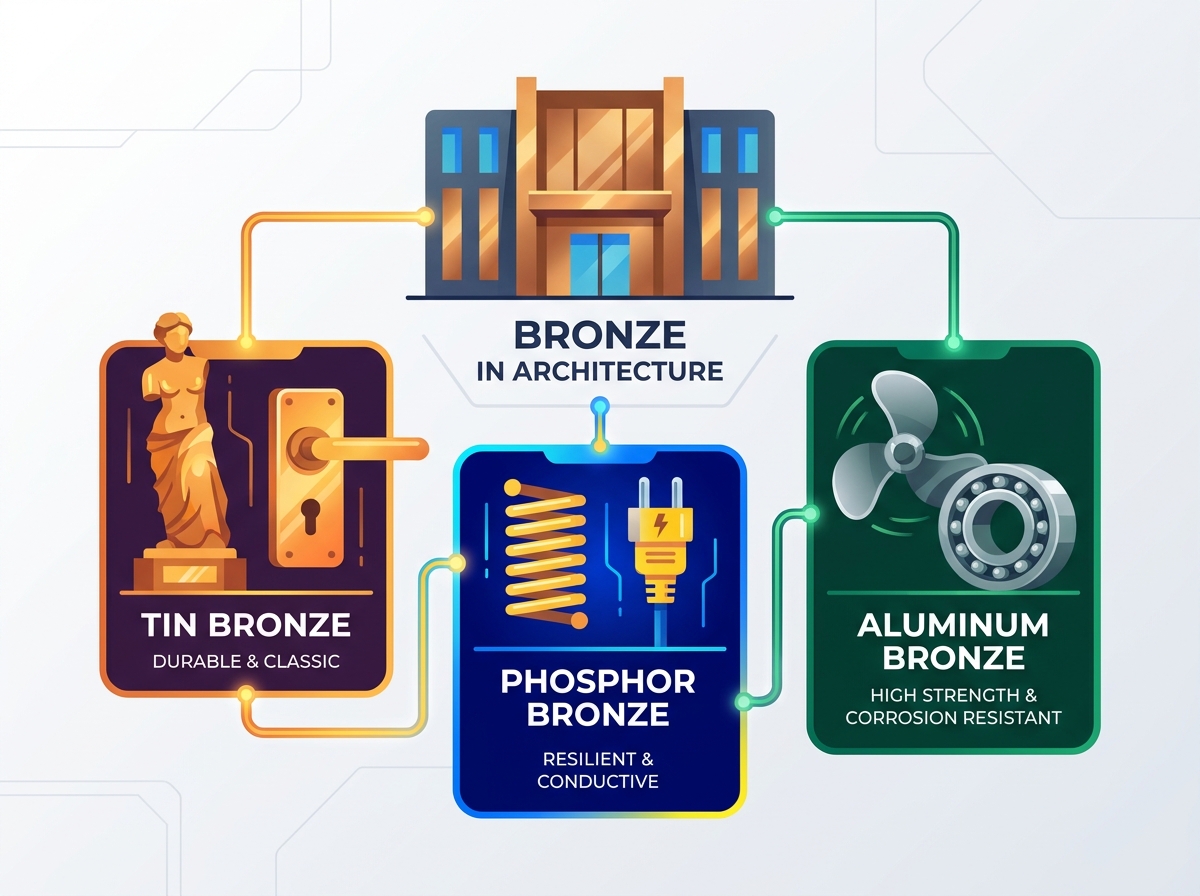
The term "architectural bronze" frequently appears in commercial trade catalogs. Specifiers must understand its actual metallurgical makeup. Commercial architectural bronze (UNS C38500) and Muntz metal (UNS C28000) are technically brasses. They contain roughly 57% to 60% copper, 40% zinc, and up to 3% lead to improve high-speed machining.
Zinc additions reduce raw material costs and allow rapid extrusion of complex glazing profiles. However, exposed zinc makes these alloys vulnerable to dezincification when subjected to chlorides, industrial sulfur dioxide, or standing moisture. Dezincification leaches the zinc out of the matrix. It leaves behind a weak, porous copper sponge prone to structural cracking. True engineering bronze materials alloy copper with tin, aluminum, silicon, or phosphorus. They intentionally keep zinc content near zero to provide true atmospheric immunity.
Historically valued for monument casting, tin bronze materials typically contain between 8% and 12% tin. They are supplemented with trace additions of nickel or phosphorus. Tin increases overall matrix hardness, improves casting fluidity, and gives the metal high resistance to atmospheric moisture.
When molten, this alloy flows readily into thin, intricate sand molds or investment cavities without tearing during solidifying shrinkage. This fluid characteristic makes it the default alloy for complex cast bas-relief panels, custom structural glazing spiders, and historic masonry anchor restorations. In exterior exposure, it forms a dense, insoluble tin oxide film beneath the outer cuprous patina. This blocks acid-rain pitting over decades of weathering.
Deoxidizing a copper-tin melt with phosphorus yields phosphor bronze materials. The residual phosphorus content (0.01% to 0.35%) refines grain size and removes dissolved oxygen. It increases the alloy's mechanical fatigue threshold and spring modulus.
This alloy shines in dynamic components that undergo frequent movement or flexing. We specify it for woven wire architectural mesh panels applied across open-air parking structures or ventilation grilles. It works perfectly for concealed tension clips and dynamic mechanical fasteners holding exterior ceramic or stone cladding tiles. You will also see it in flexible seismic joints and weatherproofing movement splices that compress and expand with diurnal thermal cycles.
When structural loads exceed the capacity of common copper alloys, specifiers turn to aluminum bronze materials. These alloys combine 9% to 14% aluminum with up to 5% iron and 5% nickel. The result is a metallurgical structure whose yield and tensile strengths match or exceed medium-carbon structural steels.
This alloy forms a microscopic, self-repairing aluminum oxide film across its exposed surface. This passive skin heals rapidly if scratched. It provides unmatched protection in chloride-heavy marine splash zones, tidal vents, and submerged fountains. When engineering primary facade tiebacks, outriggers, or dead-load anchors exposed to outdoor driving rain, this material eliminates the risk of brittle rust-jacking associated with painted carbon steel.
Plate thickness calculations for exterior facades depend primarily on yield strength under peak negative wind loads. Thin plates flex under wind suction, producing visible oil-canning ripples across building facades. While architectural aluminum requires extruded stiffening ribs welded to the panel back every 600 mm, high-strength copper alloys span broader support distances without secondary stiffeners.
Alloy Family & UNS Code | Tensile Strength (MPa) | Yield Strength (0.2% Offset, MPa) | Elongation (% in 50mm) | Density (g/cm³) | CTE (µm/m·K) |
|---|---|---|---|---|---|
Architectural Brass (C38500) | 415 | 150 | 30 | 8.50 | 20.5 |
Tin Bronze (C90500) | 310 | 150 | 25 | 8.72 | 18.2 |
Phosphor Bronze (C51000) | 470–650 | 380–550 | 15–35 | 8.86 | 17.8 |
Aluminum Bronze (C95400) | 585–720 | 240–310 | 12–18 | 7.45 | 16.2 |
Structural Steel (ASTM A36) | 400–550 | 250 | 20 | 7.85 | 12.0 |
Architectural Aluminum (6063-T6) | 240 | 215 | 12 | 2.70 | 23.4 |
These mechanical performance metrics allow engineers to design slim, elegant structural glass mullions and canopy brackets. They carry substantial dead and wind loads without excessive deflection.
Recent building envelope failures have spurred regulatory bodies worldwide to review non-combustible cladding mandates. Solid copper alloy plates and engineering castings are inherently inorganic and completely non-combustible. They achieve Class A1 fire spread ratings under European EN 13501-1. They pass United States NFPA 285 vertical flame propagation tests without special exceptions.
Metal Composite Materials rely on bonded polymer cores that can disintegrate and fuel fires when exterior barriers breach. Copper alloys melt at temperatures between 950°C and 1060°C, far higher than aluminum. During an exterior fire, aluminum mullions and panels quickly soften, warp, and fail. They drop large glazing lites onto rescue staging paths. Solid metal assemblies maintain their structural shape longer, helping contain flame breakout across intermediate floor slabs.
Uncoated metal undergoes progressive chemical reactions when exposed to atmospheric oxygen, water vapor, and ultraviolet light. Freshly machined surfaces react with atmospheric oxygen, developing a thin layer of cuprous oxide. The metal's warm golden tones deepen into rich statuary brown shades within several weeks to months. Over 5 to 25 years, sulfur dioxide, moisture, and carbon dioxide transform this surface film into copper carbonate and copper sulfate complexes. This transition forms the familiar green verdigris patina.
The mature patina forms an impermeable, highly stable shell. It seals the core metal underneath, reducing ongoing corrosion rates to near zero. Specifiers must manage copper runoff properly. Rainwater running across developing patinas carries microscopic concentrations of copper ions. If directed across porous white limestone, architectural precast concrete, or light-colored masonry, these ions bond into the pores, causing permanent green staining. Design details must include drip edges, continuous flashing kick-outs, and dedicated internal drainage troughs to guide runoff directly into building storm drains.
Metals move significantly under normal seasonal temperature changes. Copper alloys exhibit a Coefficient of Thermal Expansion (CTE) of roughly 16.2 to 18.2 µm/m·K. In comparison, standard structural steel sits around 12.0 µm/m·K, while concrete ranges from 10.0 to 11.0 µm/m·K.
On a three-meter exterior cladding panel undergoing an 80°C seasonal surface swing, the metal expands approximately 4.3 mm relative to its cold state. If designers rigidly fasten panel corners with standard circular screw holes, internal thermal stresses will buckle the plate. They will deform perimeter seals or shear fastener heads clean off. Connections must utilize slotted anchor holes, sliding step-bushings, and low-friction fluoropolymer slip pads to permit unrestrained longitudinal expansion.
Mass law states that heavier facade skins absorb airborne acoustic energy much better than light ones. With a material density near 8.8 g/cm³, copper alloys are more than three times denser than aluminum. Installing solid rainscreen cassettes improves the facade's Sound Transmission Class (STC) and Outdoor-Indoor Transmission Class (OITC) ratings. You achieve this without requiring heavy layers of internal mass loaded vinyl.
This high surface mass also reduces rain drumming noise. Light rain and heavy downpours generate sharp, resonant vibrations on thin-gauge steel and aluminum composite sheets. Thick plates dampen high-frequency impact vibrations directly. They create noticeably quieter interior living spaces within urban residential and hotel projects.
Waterjet cutting using garnet abrasive is the preferred cutting method for heavy architectural plate. Plasma and fiber lasers generate a substantial Heat-Affected Zone (HAZ) along the cut edge. This intense thermal band alters the alloy's local grain structure. It permanently changes how the cut margins react to natural weathering or chemical aging agents. Waterjet cutting cuts cleanly with cold water, preserving identical patination behavior across the entire panel face.
Welding requires precise heat control. Fabricators should use Gas Tungsten Arc Welding (GTAW/TIG) paired with exact-match bare alloy filler wires. Welding requires careful pre-heating of the workpieces to prevent micro-cracks and lack-of-fusion defects. Weld seams must be ground perfectly flush with matching mechanical graining. This prevents joint outlines from showing through the evolving surface patina.
Modern foundries have moved past traditional wood and wax tooling. Technicians now produce sand molds using direct 3D binder-jet printing from digital CAD files. This process allows engineers to design organic, structurally optimized structural nodes and glazing brackets with no need for draft angles or split pattern lines.
The molten metal provides reliable casting fluidity for complex nodes, filling delicate mold cavities without premature freezing. Foundries use post-cast 5-axis CNC machining centers to mill locating pin faces, drill structural pin holes, and ream attachment tabs down to tight tolerances. This ensures smooth drop-in field installation on jobsites.
Procuring custom engineering alloys requires careful schedule planning. Unlike standard commodity aluminum sections kept in local warehouse stock, specialty architectural extrusions and custom-width plate require dedicated casting runs at specialized non-ferrous mills. Minimum Order Quantities (MOQs) for custom extruded shapes typically run between 500 and 2,000 kilograms per cross-section.
Lead times run significantly longer than standard steel procurement. Standard warehouse plate and rod shapes take 2 to 4 weeks. Custom alloy casting melts and wide plate rolling take 10 to 14 weeks. Custom extrusion die tooling, extrusion trials, and run production take 14 to 20 weeks. Complex 3D sand-cast structural components with post-machining take 12 to 18 weeks. Engineering teams must complete structural sizing, wind tunnel validations, and alloy approvals early in the design phase to avoid jobsite installation delays.
These alloys require a higher initial material investment than common exterior metals. On raw weight alone, refined copper alloys trade at a premium over commercial aluminum and standard carbon steel. Factoring in the high density, a panel of identical thickness weighs over three times more. This drives up raw material investment per square meter.
Fabrication labor also runs higher. The metal work-hardens quickly during stamping, braking, and perforating operations. This requires heavier forming machinery and slower press cycles. Cutting and milling tools experience accelerated wear from tough alloys, necessitating lower machining feeds, specialized carbide tooling, and frequent insert replacement. The material's heavy mass also requires specialized handling equipment and hoists during shop assembly and site installation.
Long-term maintenance costs tell an entirely different story. Coated envelope assemblies rely on an organic chemical film to shield the metal beneath. Exposure to ultraviolet radiation, thermal movement, airborne salts, and micro-cracking gradually degrades this barrier. Within 20 to 30 years, building owners face expensive field repainting, panel re-skinning, or complete envelope remediation.
Uncoated natural metal requires almost no ongoing maintenance beyond occasional wash-downs with fresh water to clear away concentrated salt crusts and atmospheric dirt. The metal's self-healing patina repairs surface scratches through natural atmospheric oxidation. Owners avoid expensive scaffolding erections, volatile chemical stripping projects, and costly panel replacements over the building's operating life.
Scrap retains significant financial value. When a building eventually reaches decommissioning or adaptive reuse after decades of operation, structural steel and degraded composite cladding often cost more to remove, sort, and dispose of than their scrap value covers. In contrast, clean copper alloy plate retains a high percentage of virgin metal market value. This turns end-of-life envelope teardown into a profitable salvage recovery.
When evaluated across an extended multi-decade building lifespan, these materials provide notable embodied carbon benefits. While initial refining and smelting require considerable energy, amortizing those emissions across a hundred-year service life yields a low annual carbon footprint. Modern non-ferrous foundries utilize between 70% and 95% post-consumer and pre-consumer scrap metal. Specifying certified high-recycled-content alloys helps design teams secure points under LEED v4 Materials and Resources credits and achieve BREEAM environmental ratings.
Galvanic corrosion represents the greatest structural risk when incorporating these alloys into building facades. On the galvanic chart, they sit near the noble, cathodic end of the scale. In contrast, structural carbon steel, zinc-galvanized coatings, and structural aluminum sit far toward the active, anodic end.
If water bridges an uninsulated connection between a cassette and an aluminum rail or steel bracket, an electrical circuit forms. The active base metal rapidly corrodes, causing catastrophic anchor degradation while the noble metal remains untouched. To eliminate this issue, engineers must detail complete dielectric isolation at every interface.
Install non-hygroscopic elastomeric gaskets minimum 1.5 mm thick between dissimilar structural metals.
Use dielectric isolation sleeves fabricated from polyoxymethylene or polyamide surrounding all fastener shanks passing through dissimilar metal plates.
Place non-conductive washers backed by stainless steel pressure washers under bolt heads and nuts to prevent electrical short-circuiting.
Specify structural fasteners made from AISI 316 stainless steel or matched alloys only.
Solid cladding adds substantial dead loads to the building superstructure. A 6 mm solid plate panel assembly weighs approximately 53 kg/m² before factoring in internal stiffeners, brackets, and attachments. Facade framing must anchor back to primary concrete slab edges or structural steel spandrel beams rather than lightweight interior steel stud walls.
Engineers can reduce dead load through several proven strategies. Laminating a 0.8 mm to 1.0 mm face sheet to an aluminum honeycomb core using aerospace structural adhesives yields a flat, rigid panel weighing less than 15 kg/m². Using cold-rolled 2.0 mm or 3.0 mm sheets with continuous perimeter edge returns and integrated rear stiffeners gives large panels high structural rigidity with minimal mass. Applying finite-element topology optimization to cast structural brackets and nodes places metal only where load vectors require it, coring out non-structural pockets to lighten components.
Setting proper aesthetic expectations with building owners early is essential when working with living metals. Leaving the surface completely unfinished to age naturally yields an evolving, multi-toned facade. Panels on the north elevation will weather slower than sun-baked southern exposures. Sheltered surfaces beneath overhangs will retain deep statuary browns while open areas shift toward verdigris green.
If the design demands immediate color uniformity, panels should undergo factory-controlled chemical pre-patination. Fabricators immerse parts in mild acid baths or liver-of-sulfur solutions to deliver uniform statuary brown, Florentine, or verde green finishes before panels ship to site. Technicians then seal the pre-aged surface with microcrystalline wax to protect the tone during shipping and field erection.
If the owner insists on preserving the bright, golden hue of raw machined metal, specifiers must call for high-performance clear coatings. Thermoset fluoropolymer clear lacquers or automotive-grade acrylic urethanes with added UV inhibitors shield the surface from ambient moisture and oxygen. Even the highest-grade clear films break down under intense UV solar exposure within 7 to 15 years. They require eventual chemical stripping and reapplication to avoid patchy clouding and peeling.
To implement these architectural components smoothly on upcoming building designs, specification teams must execute the following steps:
Conduct a site-specific microclimate analysis to measure airborne chlorides, sulfur dioxide, and humidity levels before selecting the final UNS alloy designation.
Build full-scale facade mockups integrating EPDM isolation pads, dielectric sleeves, and 316 stainless steel fasteners, then run cyclic ASTM B117 salt spray tests to validate galvanic isolation.
Coordinate directly with non-ferrous foundries and plate rolling mills during the schematic design phase to secure minimum order quantities and lock in production lead times.
Draft strict maintenance manuals for the facility management team, detailing the exact wash-down procedures and prohibiting abrasive chemical cleaners that strip natural patinas.
A: Commercial architectural bronze (UNS C38500) is a brass containing roughly 57% copper, 40% zinc, and 3% lead. It extrudes easily but suffers from dezincification in marine environments. True bronzes contain tin, aluminum, or phosphorus with zero zinc. They offer higher tensile strength, impact toughness, and long-term resistance to atmospheric corrosion.
A: Specify aluminum bronze when components carry high structural loads or face severe marine environments. With yield strengths exceeding 300 MPa, it matches structural carbon steel, making it ideal for curtain wall anchors and facade tiebacks. Tin bronze is better suited for decorative architectural castings and historic hardware reproductions where intricate mold flow takes precedence.
A: Prevent galvanic corrosion by breaking electrical continuity between the cathodic copper alloy and anodic steel. Incorporate non-conductive dielectric barriers like EPDM or neoprene shims. Fastener penetrations require non-conductive isolation sleeves and washers. All structural bolts and nuts must be high-grade AISI 316 stainless steel rather than standard plated carbon steel.
A: Yes. Solid plates and cast elements are inherently non-combustible. They achieve Class A1 reaction-to-fire ratings under European EN 13501-1 standards and pass NFPA 285 vertical flame propagation tests. Unlike metal composite materials featuring combustible core layers, solid metal releases no toxic gases and does not fuel flames.
A: Copper alloys have a coefficient of thermal expansion around 16.2 to 18.2 µm/m·K, roughly 50% greater than structural steel. Exterior panels expand and contract significantly over annual temperature swings. To prevent structural warping or fastener shearing, connections must incorporate slotted mounting holes, low-friction sliding washers, and properly sized perimeter movement joints.


